
paragliding
From the basics of paragliding to gear and flight sites — everything about flying.
The history of paragliders
In 1984, French mountaineer Jean Marc Couvin created the first paraglider by modifying a parachute and succeeded in flight, which was the beginning of paragliding, which is gaining explosive popularity around the world today. As many people learned to fly easily and simply and enjoyed it, the population grew rapidly, and aviation associations in each country rushed to accept it as a new flying genre. As a result, a paragliding committee was formed within the Hang Gliding Association under each country's aviation association, and a paragliding subcommittee was also formed at the International Hang Gliding Committee (CIVL) under the Federation Internationale de Aeronautics (F.A.I.), growing into a new aviation sport. It was first introduced in Korea in 1986 and began to receive attention as a leisure air sport, and a paragliding division was formed within the Korea Gliding Association.
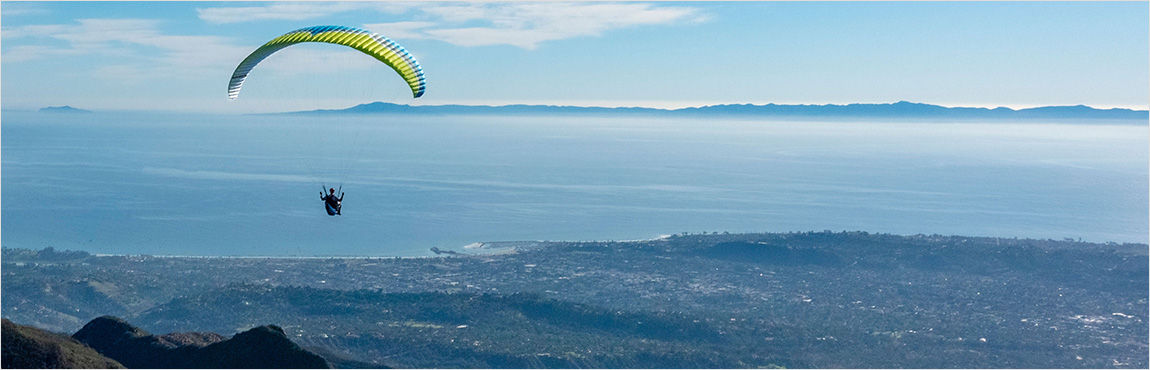
What is a paraglider?
It is a human-powered glider that combines the characteristics of a parachute and a hang glider, and has the advantages of the stability, disassembly, assembly, and transportation of a parachute and the glide and speed of a hang glider. Without a separate powerplant, a person can run or take off in place, fly, and then land on both feet. Therefore, the paraglider is a human-powered glider among ultralight aircraft, and is an air sport with the largest number of enthusiasts worldwide due to its simple operation.
A big advantage is that it is light, weighing about 4kg when folded into a backpack, and flies after hovering about 10m from the top of a mountain or ridge. The average speed is 20 to 40 km/h, and when it takes off at 10 m above sea level, it flies an average of 40 m. The wind suitable for flight is about 1 to 5 meters per second based on the head wind. After wearing a helmet and harness (equipment that connects the instrument and the body), change direction using the left and right control ropes. Landing is done using the brake handle. The average lifespan is 5 years, and the maximum exposure time to sunlight is about 300 hours.
International competitions include the World Paragliding Championships, and in Korea, the University College Championships, National Club Championships, and Army Chief of Staff Cup competitions are held every year. Competitions include passing a designated target, throwing a target, and cross-country flying over long distances. Other leisure sports that apply paragliding include paraskiing, which involves skiing the moment you land, motor-paragliding, which takes off with a propeller thruster to eliminate the inconvenience of climbing a mountain carrying a paraglider, paraplane, which has an engine and cockpit so you can fly while sitting, and tandem flight, where a professional pilot and two pilots fly together by connecting a connector. There is.
Tips for choosing a paraglider
Paragliders are sold in several classes. Although the shapes are similar, there are many differences in stability and performance depending on the class, so choosing the aircraft that best suits your body and flying is the safest and most enjoyable way to fly. Since flying is a leisure sport, you may be exposed to risks while flying. The trick to flying more safely against these risks is to select an aircraft with sufficient experience and skills.
Classification of paragliders
The German Hang Glider Association (DHV) certifies aircraft into five levels according to flight level. DHV 1 (for beginners) → DHV 1-2 (for intermediate players) → DHV 2 (for intermediate/advanced players) → DHV 2-3 (for advanced players) → DHV 3 (for athletes). Some manufacturers further subdivide DHV Grade 2 according to aircraft performance, manufacturing and selling them into DHV Grade 2, which tends to be safe, and DHV Grade 2, which tends to be safe but aggressive. In France (AFNOR), certification is simpler than in Germany and is divided into three stages. STANDARD (for beginners) → PERFORMANCE (for intermediate users) → COMPETITION (for advanced users).
| DHV certification level (level 5) | manufacturer | AFNOR certification level | |
|---|---|---|---|
| DHV Grade 1 | For beginners | For beginners | STANDARD |
| DHV 1 - 2 | For intermediate level | For intermediate level | |
| DHV 2 | For intermediate level sports | For intermediate sports players | PERFORMANCE |
| X-C for intermediate level users | |||
| DHV 2 - 3 | For advanced users | For advanced users | COMPETITION |
| DHV 3 | For top level players (for players) | For top level users | |
What is a safety inspection?
Typically, manufacturers obtain certification from the German Hang Glider Association (DHV) or the French National Standards Association (AFNOR) in order to sell their aircraft globally. If you want to sell your equipment in Germany or countries near Germany, you need to get DHV certification, and if you want to sell in France or nearby countries, you need to get AFNOR certification.
What is the safety inspection agency in Korea?
In Korea, although it occupies more than 30% of the global market share, no organization has yet been formed to conduct safety inspections, and it is mainly sold as products certified by foreign countries such as DHV and AFNOR.
Are there any safety inspections?
Aircraft safety inspection is conducted by grade. For example, DHV class 1 aircraft are much safer than other class aircraft in safety inspection items and are designed to easily recover on their own even in dangerous situations.
What is the functional relationship between maneuverability and safety?
It is impossible to have a glider that is both very stable and very maneuverable. In general, controllability and stability are always inversely proportional, so good stability leads to poor controllability, and good controllability leads to poor stability.
Which aircraft should I choose to fly?
First-time beginners should, of course, select and fly a DHV Class 1 (or AFNOR STANDARD) aircraft. As your skills improve by flying a lot with a class 1 aircraft, you will need to upgrade to class 1-2, class 2, etc. If you are a leisure flyer, we recommend that you select an aircraft up to class 2 and fly.
Aircraft selection based on number of flights, flight time, and years of flight
| DHV 1 grade gas | DHV 1-2 grade gas | DHV 2 class aircraft | DHV 2-3 grade gas | DHV 3 grade gas | ||
|---|---|---|---|---|---|---|
| Type N | XC type | |||||
| Applicable model (currently sold model) | Element, Mojo2 | Buzz Z, RUSH, GEO, Ultralite (for mountaineering), magnum (2-seater) | Addict 6907 (Acro only) | Addict R | M2 | Mantra R |
| flying career | After completion of training upon entry | More than 1 year | 2 years or more | 2~3 years or more | 4 years or more | |
| annual flight time | 50 hours or less | More than 20 hours per year | More than 30 hours per year | More than 50 hours per year | More than 100 hours per year | |
| characteristic | Suitable for those who enjoy leisure activities on weekends or fly 1-2 times a month. | It is a class 1 aircraft and is suitable for those who want to fly more actively while handling thermal flow and slope flight. | Suitable for those who find it burdensome to fly in a class 3 aircraft and want to fly actively in a more comfortable state. | It is difficult to fly at level 3 and is suitable for advanced pilots who do not fly as a player. | Athletes who participate in various competitions | |
| Selection Tips | It is recommended to move up the aircraft in order, starting with class 1 aircraft. | |||||
The dangers of choosing a glider of too high a level when first starting out.
Manufacturing a paraglider and selling it according to its class means that the flight performance, such as safety, turning, and speed, is different depending on the characteristics of the aircraft. Beginners do not yet have the ability to deal with dangerous situations, so if you choose a paraglider higher than your level to fly, you are more likely to be exposed to danger. Paragliders may stall or spin due to excessive handling by the pilot, and wing folding, spin, spiral, etc. may occur due to external influences (sideways, rain, or keystrokes due to gusts of wind, etc.). This phenomenon occurs more easily with intermediate and advanced paragliders than with beginner aircraft, and recovery time also becomes longer. The choice of a highly rated glider by an inexperienced pilot or a beginner who does not know how to deal with external influences significantly increases the probability of an accident. Therefore, a beginner paraglider is perfect for beginners, and an intermediate paraglider is perfect for beginners, and "DHV level 1 or STANDARD level" is usually suitable for first-timers. Don't be greedy for a grade higher than your abilities. If you choose the wrong aircraft and get injured while flying, you may regret it for the rest of your life.
Risks of choosing an aircraft one size larger than your own body weight
Paragliders have different sizes for each model and are roughly divided into XS, S, M, L, XL, etc. Each production company provides guidance on the appropriate weight for that size. For example, the S size generally has a WEIGHT IN FLIGHT of at least 70kg and maximum at 85kg. (Weight during flight = the weight of the paraglider, harness, helmet, auxiliary mountain, etc. plus the weight of the pilot. Usually, the remainder after subtracting the weight of the pilot is about 20kg.) In other words, the value obtained by subtracting about 20kg from the weight during flight is the appropriate weight for the pilot, and size S is usually suitable for pilots weighing 50 to 65 kg.
If you select a large airframe without considering these sizes and the weight of the pilot (if the pilot who should have chosen S chooses M), the following problems arise:
First, the forward speed (glide speed) in flight becomes slower.Because you fly at a slower speed than the average speed for your appropriate weight, if you encounter a strong wind or even a slightly strong wind during flight, you may be pushed behind a mountain and not be able to fly properly, and the risk of being injured by being pushed by the wind and hit by a vortex increases.
Second, wing folding easily occurs when exposed to external influences (such as gusts of wind) during flight.Therefore, there is a risk that it can easily enter spins or spirals. Therefore, it is recommended that paragliders look at the product specifications and choose one that is appropriate for their weight.
Features when selected sequentially according to the steps from the beginning
When you are a beginner or have little flying experience, you are less sensitive to the shaking and folding of the paraglider due to external influences than intermediate or advanced users. Therefore, if a beginner chooses a safer paraglider, they can be guaranteed more safety from wing folding, stalling, spin, spiral, etc. By flying a safety-guaranteed aircraft for about 1-2 years, you can gain a lot of experience and fly with confidence, so you can enjoy paragliding for a long time. Usually, these people enjoy flying for more than 5 years. If you plan to enjoy it as a leisure activity for a lifetime, not just for a year or two, we recommend that you advance through the stages sequentially.
Ask a leader who knows enough about the equipment before purchasing it
When choosing a paraglider, you can select the most appropriate aircraft by consulting with the school principal (instructor) you belong to. Your instructor will choose the most ideal aircraft for you, taking into account your kinesthetic abilities, number of flights per month, age, number of flights, etc.
Information on certification management regulations
| Certification type | certificate of issuance | flight limit |
|---|---|---|
| 2-seater experience flight | Certificate issuance | You can fly with a two-seater pilot. |
| daily experience flight | Certificate issuance | Practice flights can be conducted under the supervision of an instructor or higher. |
| Basic experience course | Issuance of certificate of completion | Practice flights can be conducted under the supervision of an instructor or higher. |
| basic course | Issuance of certificate of completion | Practice flights can be conducted under the supervision of an instructor or higher. |
| Trainee Pilot (Orange-Pilot) | Certificate issuance | Practice flights can be conducted under the supervision of an instructor or higher. |
| Pilot | Certificate issuance | You can fly at your own discretion at any glide range and participate in competitions. However, if there is a decision to prohibit flying based on the weather judgment of the leader or higher, this must be followed. |
| Advance Pilot | Certificate issuance | You can fly at your own discretion at any glide range and participate in competitions. However, if there is a decision to prohibit flying based on the weather judgment of the leader or higher, this must be followed. |
| Tandem Pilot | Certificate issuance | You can fly at your own discretion at any glide range and participate in competitions. However, if there is a decision to prohibit flying based on the weather judgment of the leader or higher, this must be followed. |
| Instructor | Certificate issuance | A flight ban decision can be made by judging the weather according to flight regulations, and training pilot and pilot qualifications can be reviewed and issued or recommended for issuance. |
| Head Instructor | Certificate issuance | It is the same as the instructor's flight limit, allows for review and issuance of learner pilot and pilot qualifications, and allows for review and issuance of instructor qualifications. |
Qualification standards and required completion items for each category and certification
2-seater experience flight / one-day experience flight
2-seater experience flight— Experience / 1 flight
daily experience flight— Experience / 1 day ground training and 30m flight once
Basic experience course (4-day course)
Eligibility Criteria— Those who have completed a basic experience course conducted by an association-accredited school · Those aged 14 or older (parental consent required for those under 18)
Required subjects (theory)— Includes 2 hours of lectures per 45-minute class in 5 subjects: law, meteorology, aviation equipment, aerodynamics, and flight technology.
Required subjects (practical training)— Training is conducted as follows under the supervision and coordination of the flight school principal.
- Flight preparation ground practice: equipment handling and inspection, pre-takeoff inspection, five-point inspection before departure. Practice lifting, running, steering and landing for safe paraglider handling on the ground.
- Training flights: 10 solo practice flights at a 40m training range and flight practice according to the training plan.
- Low-altitude flight: 4 flights including a leader and two-seater flight (less than 400m)
Basic course theory education
Basic course hands-on training
- Equipment handling, assembly and disassembly
- Practice raising the canopy, running, maneuvering, and landing.
- Departure preparation, pre-takeoff inspection and departure 5-point inspection
- Driving on flat ground (open phase)
- Correction for tilt (maneuvering and decision making)
- Driving on slopes (acceleration and departure)
- Departure, adjustment of flight speed
- Turning up to 90 degrees / S-shaped turning of 45 degrees
- landing flight towards target
- Video and photo analysis / U-shaped approach
- Rotational flight using weight shift (direction change due to weight shift)
- Assisted parachute opening image training
Basic course (6 days course)
Eligibility Criteria— Same as the basic experience course (parental consent required for those under 18)
Required subjects (theory)— Same as basic experience course
Required subjects (practical training)— It is the same as the basic experience course, and rear takeoff and ground handling are added to the basic course practical training.
Trainee Pilot (Orange-Pilot)
Eligibility Criteria— Those who have completed a basic course conducted by an association-accredited school · Those aged 14 or older (parental consent required for those under 18)
Curriculum Guide— As a qualification to practice high-altitude flights only under the supervision of an instructor or higher, at least 30 flights must be conducted in an area with an altitude difference of 300 m or more (where at least 360 degrees of rotation is possible) according to the flight school's training plan. At this time, up to the first five flights may be conducted as two-seater flights depending on the conditions of the flight school.
Required subjects (theory)— It must include at least 2 hours of theoretical lectures per 45-minute class in the fields of law, meteorology, aviation equipment, aerodynamics, and flight technology.
Required subjects (practical training)— Designated practice tasks are as follows, and each flight school conducts training under the supervision and coordination of the flight school principal.
- Preparation for departure: Knowing how to use and adjust the equipment worn, adjusting it to suit your body type, parachute use simulation training, simple flight plan according to the instructor's explanation of the departure location and glide area
- Departure: Rear start technique and video/photo analysis from an inclined starting area
- Flight: Adjusting speed with brakes to maintain straight flight at maximum glide and minimum sink rate, pitching and rolling operations to understand aircraft stability, figure-8 turn for 35 seconds, folding and releasing the aircraft using one line while holding the opposite brake, left and right rotation using weight transfer while holding the opposite brake.
- Landing: U-shaped/S-shaped turning approach, landing within 50m × 50m under various wind speed conditions.
- Additional training: Steering using the rear riser, spiral-dive (1-1-1), simulating the folded state during flight, folding using one line and then rotating in the opposite direction, landing using the over-pulling method.
Trainee pilot course theory training subjects
- Laws: equipment, flight rules, general traffic rules
- Meteorology: Low pressure areas and progression, cyclonic and anticyclonic flow, dynamic and thermal turbulence, weather forecast and additional information.
- Flight equipment: personal equipment
- Aerodynamics: glider speed range, wings and profile, rotation and axis
- Aircraft: Rear departure, special landing situations
Trainee pilot course practical training subjects
- Harness control/parachute release virtual training
- Simple flight plan according to the glide field take-off and landing site explanation
- Various aspects of rear starting / rear starting on slopes (video and photo analysis)
- Speed control using brakes (maximum glide, minimum sink)
- 360 degree turning / turning by active weight shift
- Active steering practice (beginner pitching and rolling)
- Figure 8 flight for 35 seconds
- Hold the brake on the opposite side and fold using one line / ear fold (rotate left and right using weight transfer)
- U-shaped turning approach (holding point, tailwind section, crosswind section, final approach section) / S-shaped turning approach
- Landing within 50m × 50m under various wind speeds
- Control using rear riser / Spiral-dive (1-1-1)
- Ground handling (game)
- Hold the brake on the opposite side, fold in one line, then rotate in the opposite direction / Land using the over-pulling method.
Pilot
Eligibility Criteria— Those who are 14 years of age or older · Those who have flown more than 100 times after obtaining learner pilot qualifications · Those who have flown more than 30 hours after obtaining learner pilot qualifications (parental consent required for those under 18 years of age)
Curriculum Guide— Pilot qualification is granted without time limit for free flight, excluding long-distance (X-C) flights. To be considered for qualification, a period of at least one year after obtaining a learner pilot qualification and at least 30 solo high-altitude flights in five different areas with an altitude difference of more than 300 meters are required. This must include at least 10 flight practices based on the training plan at the glide field and at least 10 flights (thermal flights) with an altitude difference of 500 m or more from the take-off site. To be issued Parapro 4, the international pilot qualification level, a total of 20 hours of flight time must include at least 5 hours each of slope climb flight and thermal flow time.
Required subjects (theory)— Must include at least 5 hours of theory lectures per 45-minute class in a specialized field (laws, meteorology, aviation equipment, aerodynamics, flight technology).
Required subjects (practical training)— Designated practice tasks are as follows, and each flight school conducts training under the supervision and coordination of the flight school principal.
- Preparation for departure: selection of departure location, planning according to flight area
- Ground handling: Various rear takeoff methods, controlled with D-riser
- Takeoff: Starting techniques in various wind conditions/locations, starting with a crosswind of up to 45 degrees (canopy tilted toward the starting direction), practicing stopping the start, raising the aircraft with one side folded, starting backwards.
- Flight: Speed control using brakes and accelerators, steering with the rear riser, turning at various angles and speeds, conscious stopping from strong pitching and rolling, figure 8 rotation for 28 seconds, folding the aircraft using two rows while holding the brakes on the opposite side, then releasing and maintaining straight flight, turning 90 degrees left and right using body weight while using the accelerator with ears folded, ascending due to upward wind on a slope, and ascending to an altitude of over 200m using heat currents 5 times.
- Landing: U-shaped, S-shaped, and 8-shaped approach, landing using the flaring/over-pulling method within 30m × 30m under various wind speed conditions.
- Others: Descent method when landing on a tree, aircraft recovery method
- Additional training: B-stall, Spiral-dive (1-2-1)
Pilot Course Theory Training Subjects
- Laws: airspace, special features of paragliding, insurance
- Meteorology: Slope winds and Venturi effect, mountain local winds, thermal formation and processes, thunderstorms, fog, clouds and weather forecasting.
- Flight equipment: Parachute
- Aerodynamics: Resistance, turning, glider characteristics and size
- Aircraft skills: extreme flight situations, emergency descent methods
Pilot Course Practical Training Subjects
- Flight plan based on selection of takeoff/landing site and flight area
- Various rear starting methods / starting from various wind conditions and locations
- Practice starting/stopping in a 45 degree crosswind (at an angle to the starting direction)
- Raising the aircraft while folded on one side / Rear takeoff
- Speed control using brakes and accelerators
- Rotating at various angles and speeds / Conscious stopping from strong pitching and rolling
- Figure 8 flight for 28 seconds / Hold the brakes on the opposite side and use two lines to maintain a straight line in a folded state
- Rotate left and right 90 degrees using weight shift while using accelerator in folded state
- Ascend using slope upward winds / ascend to an altitude of over 200m using heat currents 5 times
- U-shaped turning approach (waiting, tailwind, crosswind, final approach) / S-shaped, figure-8 turning approach
- Landing within 30 × 30m under various wind speeds / Landing using the over-pulling method
- Descent method when landing arboreally / Aircraft recovery method
- B-stall / Spiral-dive(1-2-1)
Advance Pilot
Eligibility Criteria— Persons over 18 years of age · After obtaining a pilot qualification, submit a certificate of flight history (via GPS) for a total of 30 hours or more and 5 or more long-distance (20km or more) flights (parental consent required for those under 18 years of age)
Curriculum Guide— Professional pilot qualification is an expansion of pilot qualification to long-distance flight qualification, and allows participation in various domestic and international competitions in the form of long-distance flight. There is no time limit, but if a Sporting License is issued for participation in international competitions, the FAI seal must be affixed every year. For qualification screening, after obtaining pilot qualifications, a solo long-distance flight experience of at least 20 times, 30 hours, and 200 km (cumulative total distance in online contest format), including practical training content regardless of altitude difference, is required. At this time, at least 5 long-distance flights (each at least 20 km or more) using various elevations, rather than flights using only slope elevation, must be included.
Required subjects (theory)— Must include at least 13 hours of theoretical lectures per 45-minute lesson in a specialized field (meteorology, flight skills [flight functions and attitude in special situations], navigation [flight planning using maps, how to use GPS and analysis programs]).
Required subjects (practical training)— Designated practice tasks are as follows, and at each flight school, long-distance flight instructor pilots provide training under the supervision and coordination of the flight school principal.
- Preparation for departure: Establish your own flight plan according to the flight area
- Ground handling: Simulation of aircraft folding and various controls
- Takeoff: Starting techniques in various wind conditions and locations, starting forward and backward in crosswinds up to 90 degrees (canopy placed sideways in the wind direction), pulling the aircraft backwards with one side folded.
- Flight: Straight flight close to stall speed with speed control and brakes using accelerator under various conditions, active pitching/rolling to cause shooting/folding and immediate/conscious stopping, 24-second figure-of-eight turn, folding to 50% while holding the opposite brake and maintaining course, choice between B-stall or Spiral-dive (1-3-1), 360-degree turn near the slope, rising with heat flow to the bottom of the cloud and then another Changes to thermal flow and rises, rises to thermal flow, crosses valley and rises again
- Landing: Approach with ears folded, precision landing within a 10m radius at all wind speeds and landing site conditions, Flaring·Over-pulling·Pendulum landing, emergency landing, top landing
- Other: Parachute opening gym practice
- Additional training: B-stall, Spiral-dive (1-3-1), fold to 50% while holding opposite brake, then rotate to other side, double fold while using speed system.
Professional pilot course theory training subjects
- Meteorology: X-C method, thermal flying and dangers of X-C
- Aircraft skills: extreme flight situations, emergency descent, control of flight speed
- Navigation: Flight planning using maps, how to use GPS analysis programs
Professional pilot course practical training subjects
- Flight area selection and independent flight plan / Departure from various wind conditions and locations
- Starting with a 90 degree crosswind (side to the wind) / pulling the aircraft backwards with one side folded
- Speed control with accelerator under various conditions / straight flight close to stall speed
- Immediate and conscious stop after inducing shooting through active pitching / Immediate and conscious stopping after inducing folding through active rolling
- Figure 8 flight for 24 seconds / Hold the opposite brake, fold to 50% and maintain course
- B-stall and Spiral (1-3-1) / 360 degree rotation near the slope
- The heat flow rises to the bottom of the cloud, then changes to another heat flow and rises again / The heat flow rises, crosses the valley, and then rises again.
- Approach with ears closed / Land within a 10m radius at all wind speeds and landing conditions.
- Landing using the pendulum method / emergency landing / parachute opening gym practice
- Hold the opposite brake and fold to 50%, then rotate in the opposite direction / fold in two lines while using the speed system.
Tandem Pilot
Eligibility Criteria— Those over 18 years old · Holder of a learner pilot license and own a two-seat personal aircraft · Those who just enjoy the ride (parental consent required for those under 18 years of age)
Curriculum Guide— The two-seater pilot qualification is for the enjoyment of using a two-seater paraglider. A record of 50 or more two-seat flights is required, and the first 5 flights will be flown with a pilot of leader level or higher and a trainee on board. After that, if there are no problems after 10 flights with a pilot of leader level or higher as a passenger, a flight with a pilot level or higher qualification can be permitted. You can apply for certification issuance evaluation only when it is confirmed that there were no accidents in 35 flights with such a passenger. Qualifications issued after passing a practical evaluation are issued indefinitely.
Required subjects (theory)— Must include at least 4 hours of 45-minute classes in the areas of laws, flight equipment, flight techniques (including flight techniques and attitudes in special situations), and occupant protection.
Required subjects (practical training)— Designated practice tasks are as follows, and training is conducted by instructor pilots at each flight school under the supervision and coordination of the flight school principal.
- Preparation for departure: Establish your own flight plan according to the flight area
- Ground handling: rear takeoff
- Takeoff: Take off forward or backward in crosswinds up to 45 degrees (canopy tilted to the wind direction)
- Flight: Straight flight with brakes (maximum glide, minimum sink rate) under various conditions, steering with the rear riser, immediate and conscious stopping by making strong pitching and rolling, 35-second figure-8 turn, folding to 50% while holding the opposite brake and maintaining course, B-stall or spiral-dive (1-2-1), 360-degree turn near a slope.
- Landing: U-shaped, S-shaped, and 8-shaped approach, precision landing within a 10m radius at all wind speeds and landing site conditions, Flaring, Over-pulling, and Pendulum landing methods.
- Other: How to place a rider in a harness
- Additional training: first aid, speed control using trim risers and response to collapsing.
Two-seater pilot course theory training subject
- Laws: vicarious liability, insurance
- Equipment: characteristics, harness, flight device, parachute
- Aircraft skills: Departure preparation/departure/takeoff/extreme flight situations/approach/landing/passenger protection
2-seater pilot course practical training subject (same ride with instructor)
- Independent flight plan / ground handling (rear departure method) depending on the flight area
- Practice starting/stopping in a 45 degree crosswind (at an angle to the starting direction)
- Speed control with brakes in various conditions (maximum glide, minimum sink rate) / Control using rear riser
- Conscious stopping from strong pitching/rolling / 34 seconds of figure 8 flight
- Hold the brake on the other side and keep straight while folded 50% / Rotate at various angles and speeds
- B-stall, Spiral-dive(1-2-1) / 360 degree rotation near the slope
- How to place a rider in a harness
- U-shaped turning approach (waiting, tailwind, crosswind, final approach) / S-shaped, figure-8 turning approach
- Landing within 10m at all wind speeds and landing site conditions / Landing using Flaring·Over-pulling·Pendulum methods
- First aid / speed control using trim risers and response to collapsing
Instructor
Eligibility Criteria— Persons over 18 years of age (parental consent required for those under 18 years of age)
Curriculum Guide— He holds a professional pilot's license, and this qualification allows him to take unspecified ordinary people on board.
Required subjects (theory and practice)— Same as the two-seater pilot course