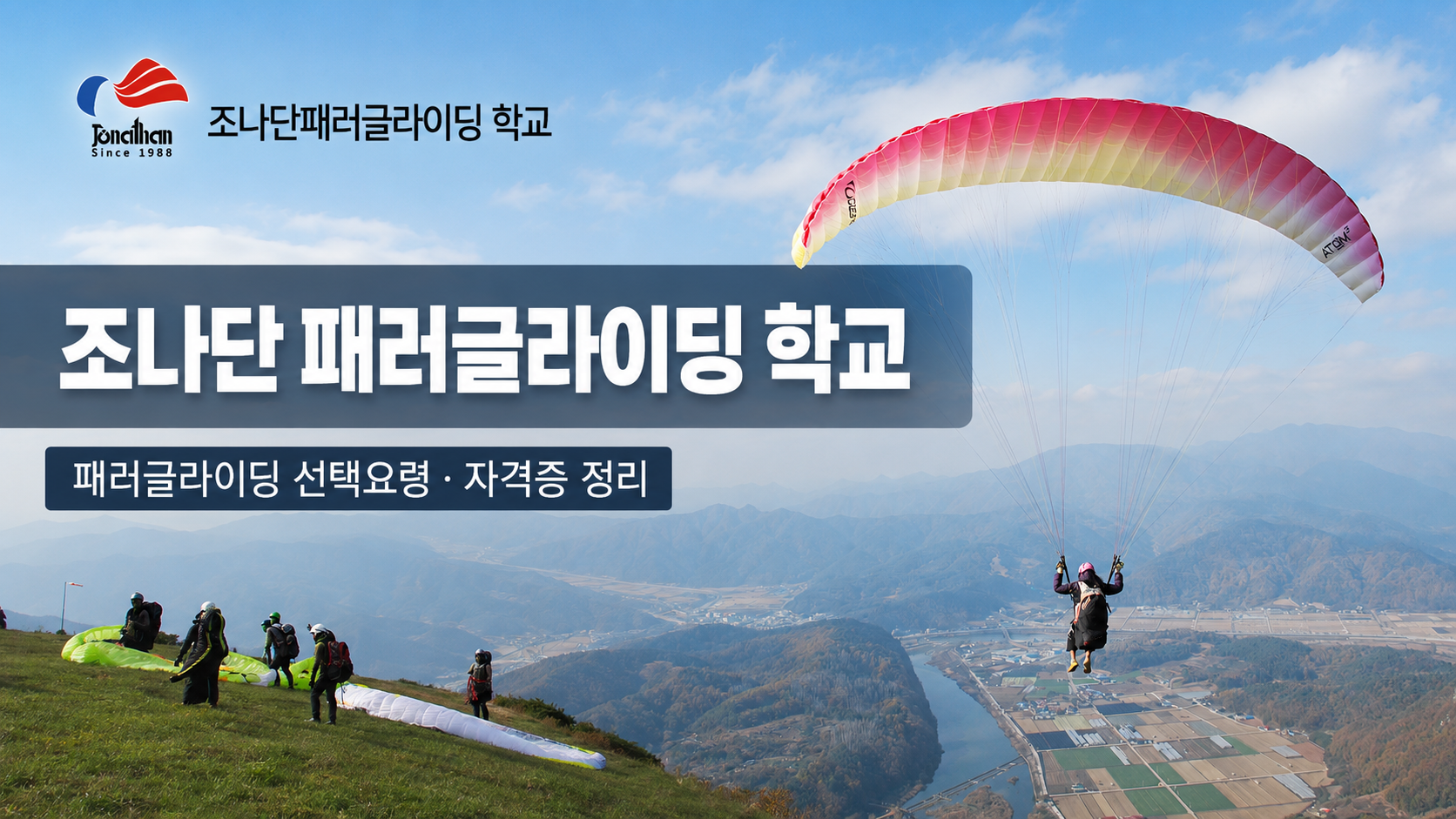
People who are learning about paragliding for the first time usually think of the flying experience. However, in order to control the aircraft yourself and fly safely at various glide sites, it is important to understand the characteristics of the equipment and complete a training course that suits your skills step by step.
Jonathan Paragliding School , located in Pyeongchang-eup, Pyeongchang-gun, Gangwon-do, has been providing paragliding education since 1988. This is a place that operates step-by-step programs ranging from two-seater experience flights for beginners to basic training, learner pilot, pilot, professional pilot, and instructor courses.
In this article, we will take a look at the operating philosophy of Jonathan Paragliding School, as well as paragliding selection tips, types of certifications, qualification standards and required completion items.
What kind of place is Jonathan Paragliding School?
The name of Jonathan Paragliding School was taken from Jonathan Livingstone, the main character in Richard Bark's novel The Seagull's Dream.
Like a seagull trying to escape from its daily routine and fly higher and more freely, Jonathan embodies the meaning of dreams and challenges toward the sky in his educational philosophy.
Jonathan Paragliding School held its founding ceremony in 1988 at the Baekun Mountain Gliding Center in Yeongjong Island, and has continued to provide paragliding education and equipment-related services since then.
The main history is as follows.
- April 1988, founded by Jonathan
- May 1990, Jonathan Paragliding School and Shop opened
- 1991 Recognized as an official educational institution by the Korea Gliding Association
- 1996 National Sports Association National Paragliding Association Certified School
- 1999 Jonathan website opened
- 2002 Seoul office established
- 2005 Headquarters relocated to Seoul office
- 2007 Happy 700 Pyeongchang Training Center Founded
Currently, Pyeongchang Education Center is located at 209-5 Noramdeul-gil, Pyeongchang-eup, Pyeongchang-gun, Gangwon-do.
What does the name Jonathan mean?
Jonathan's symbol embodies the spirit of safety, challenge, and flight in harmony with nature.
Blue symbolizes the most important safety in paragliding. Adventure and challenge are important, but this means that safety must be prioritized while considering responsibility to family and society.
Red symbolizes challenge, youth, ambition and will toward dreams and ideals. Here, youth does not mean physical age, but the spirit of making efforts to make dreams a reality.
Black represents oneness with nature, a clean mind, and the spirit to overcome difficulties.
Jonathan Mark's overall shape represents the wings of a paraglider, a seagull, and an aviator sitting in a harness.
What are the educational characteristics of Jonathan Paragliding School?
Jonathan Paragliding School not only operates experience flights, but also has an education system that covers everything from beginner training to intermediate and advanced training and athlete training.
Representative training and experience courses are as follows.
- Two-seater experience flight with a professional pilot
- Step-by-step training from ground training to solo flight
- According to association standards Paragliding certification course
- Motor paragliding training that allows you to take off and land on flat ground using the engine
- Equipment sales and inspection/repair consultation
- Developing intermediate and advanced pilots and players
Safety is also an important operating principle, including checking weather conditions and equipment before each flight and providing guidance on the insurance system for all flights.
What kind of air sport is paragliding?
Paraglider is a human-powered glider that combines the stability and portability of a parachute and the glide and speed of a hang glider.
The pilot takes off from the top of a mountain or ridge without a separate power device, and lands on both feet after flight.
The general characteristics of paragliding are as follows:
- Aircraft weight approximately 4kg
- Average flight speed approximately 20~40km per hour
- Appropriate wind speed based on headwind 1~5m per second
- Average lifespan of aircraft Approximately 5 years
- Maximum exposure time to sunlight Approximately 300 hours
- Change direction using left and right brake control lines
- Wear safety equipment such as harness, helmet, auxiliary parachute, etc.
Paragliding is relatively easy to carry equipment and has a simple operation method. Although it is simple, it is an air sport that is directly affected by wind and terrain, so training and safety inspection are required.
What is the most important thing in choosing paragliding?
The most important criterion in selecting paragliding is selecting an aircraft that suits your flying skills.
Even aircraft with similar appearances have different stability, controllability, speed, and recovery characteristics after wing folding depending on the class.
If a first-time user chooses a mid- or upper-level aircraft with high performance, it may be difficult to respond when the aircraft folds due to gusts of wind or overoperation.
Therefore, beginners should start with beginner-level aircraft with high stability and self-recovery, and gradually move to higher levels depending on their flying experience and level of training. How are the
paraglider aircraft classes classified?
Jonathan Paragliding School's information materials explain aircraft ratings focusing on German DHV certification and French AFNOR certification.
DHV classes are divided into:
- DHV 1: For beginners
- DHV 1-2: For intermediate users
- DHV 2: For sports and intermediate players
- DHV 2-3: For advanced players
- DHV 3: For advanced players and athletes
AFNOR certification is a relatively simple three-step process:
- STANDARD: For beginners
- PERFORMANCE: For intermediate users
- COMPETITION: For advanced users
For beginners, it is recommended to select an airframe that prioritizes safety, such as DHV 1 or AFNOR STANDARD grade.
What is the relationship between safety and maneuverability?
The stability and controllability of a paraglider generally tend to be inversely proportional.
The highly stable entry-level aircraft recovers relatively easily from hazardous situations, but its agile handling capabilities may be limited.
Conversely, athlete aircraft with high controllability and speed performance respond sensitively to the pilot's commands, but require faster and more accurate response capabilities in dangerous situations such as wing folding or stalling.
Therefore, just because an aircraft has high performance does not mean it is good for all fliers. You should choose one based on your number of flights, level of education, annual flying hours, and kinesthetic sense.
Why is it dangerous for beginners to choose a high-grade aircraft?
Beginners may not have sufficient response ability when experiencing situations such as wing folds, stalls, spins, and spirals.
Intermediate or athlete aircraft are more responsive than beginner aircraft, but often require longer recovery times from hazardous situations or require manual intervention by the pilot.
If a beginner does not respond appropriately when part of the wing is folded or the pilot over-manoeuvres due to gusts or turbulence, the likelihood of an accident may increase.
The key to choosing paragliding is to choose safe equipment that suits your current skills rather than high performance.
How to choose paraglider size?
Paragliders are divided into sizes such as XS, S, M, L, and XL, and each aircraft has an appropriate flight weight.
Flight weight is not only about the weight of the pilot.
You must add up the weight of the following equipment:
- Pilot's weight
- Paraglider aircraft
- Harness
- Helmet
- Auxiliary parachute
- Other flight equipment
Generally, the weight of personal equipment can be calculated to be about 20 kg, so you must subtract the equipment weight from the aircraft's appropriate flight weight to check the size appropriate for your body weight.
Choosing an airframe larger than your needs can result in slower forward speeds and a greater chance of being pushed back by strong winds or having the wings folded easily by gusts.
Therefore, it is recommended that you consult with your instructor before choosing the aircraft size.
What types of paragliding certifications are there?
The paragliding certification and training completion process is divided into stages from experience to instructor.
Representative categories are as follows.
- Two-seater experience flight
- One-day experience flight
- Basic experience Course
- Basic Course
- Trainer Pilot
- Pilot
- Professional Pilot
- Two-Seater Pilot
- Leader
- Senior Instructor
A certificate or certificate of completion is issued for the experience flight and basic courses, and for the learner pilot course and above, the certificate issuance process begins after meeting the standards.
Who is the two-seater experience flight suitable for?
2-seater experience flight is a process of flying with a professional pilot without separate pilot training.The
aviator is ideal for those looking to take to the skies for the first time as they fly tethered to a pilot and a single paraglider.
Before the experience flight, you will receive basic guidance on flight posture, how to run during takeoff, and leg posture when landing.
However, actual flight availability may vary depending on weather conditions such as wind speed and direction, and presence of precipitation on the day.
What will you learn in the basic experience course?
Basic Experience Course is an introductory course conducted at an association-accredited school and consists of a 4-day course based on guidance materials.
eligibility criteria are as follows:
- Ages 14 and above
- Parental consent required for ages 18 and below
- Complete the curriculum at an association-accredited school
Theoretical education consists of the following five areas.
- Legislation
- Meteorology
- Flight Equipment
- Aerodynamics
- Flight skills
In practical training, you will learn equipment handling and inspection, canopy raising, running, piloting, and landing practice.
The main practice contents are as follows.
- Equipment assembly and disassembly
- Pre-takeoff inspection
- Departure 5-point inspection
- Driving on flat and sloped terrain
- Canopy tilt correction
- 90 degree turning
- S-shaped turn
- Landing at target point
- Change direction using weight transfer
- Auxiliary parachute opening image training
- Flight video and photo analysis
What is the difference between the basic course and the basic experience course? The
basic course runs as a 6-day course based on the information materials.
The basic theory and practice items are similar to the basic experience course, but rear takeoff and ground handling training are added.
Rear takeoff is a method in which the pilot raises the aircraft while looking at the canopy, then turns and takes off. It is often used in actual flights because it allows you to directly check the aircraft condition in windy situations.
Ground handling is training to raise, maintain, and control the canopy stably on the ground. It is an important process for safe takeoff.
What are the training pilot qualification standards and requirements?
Trainer pilots are at the stage where they can practice high-altitude flights under the supervision of an instructor or higher.
eligibility criteria are as follows:
- Completion of basic course at an association-accredited school
- Age 14 or older
- Parental consent is required if you are under 18 years of age.
At least 30 flights must be conducted in areas with an altitude difference of more than 300m. Some initial flights may be conducted in a two-seater format depending on school conditions.
Theory training includes laws, meteorology, personal equipment, aerodynamics, rear departure and special landing situations.
The main practice topics are as follows:
- Harness adjustment and equipment use
- Parachute release virtual training
- Flight planning
- Rear departure
- Speed control using brakes
- Maximum glide and minimum sink flight
- Pitching and Rolling Training
- Figure 8 Flight
- Ears
- U-shaped and S-shaped landing approach
- Landing within 50m×50m
- Rear riser control
- Spiral Dive Basics
- Ground Handling
What are the pilot qualification standards and requirements?
Pilot qualification is a step toward flying more freely after completing the learner pilot course. The eligibility criteria presented in the
fact sheet are as follows:
- Ages 14 and over
- More than 100 flights after acquiring learner pilot qualification
- At least 30 hours of flight time after obtaining learner pilot qualifications
- At least 1 year of flight time after qualifications
- At least 30 solo high-altitude flights in 5 different regions
- Completion of designated flights, including thermal flow flights
In the pilot course, pilots learn the ability to review departure points and flight areas on their own and make flight plans considering weather and terrain.
The main practice contents are as follows.
- Front and rear takeoff in various winds
- Crosswind takeoff
- Departure Abort Training
- Raising the aircraft with one wing folded
- Speed control using brake and accelerator
- Rear riser control
- Pitching and rolling control
- Use of ear folding and accelerator
- Slope upwind flight
- Ascent using thermal flow
- U-shaped, S-shaped, and 8-shaped landing approach
- Landing within 30m What are the qualification criteria and completion items?
- Professional Pilot is a course for pilots considering long-distance flights and participation in domestic and international competitions.
- eligibility criteria are as follows:
- 18 years of age or older
- Pilot qualification
- After obtaining pilot qualification Total flight time of more than 30 hours
- More than 5 long-distance flights of 20 km or more confirmed by GPS records
- Total of 20 long-distance flights, 30 hours, 200 km or more solo long-distance flights
- In the professional pilot course, you learn meteorology, long-distance flight hazards, extreme flight situations, flight speed control, and navigation using maps and GPS.
- The main practice items are as follows:
- Establish your own long-distance flight plan
- 90-degree crosswind takeoff
- Straight flight close to stall speed
- Active pitching and rolling control
- Maintains course when the aircraft is 50% folded
- Valley crossing using thermal flow
- B-stall or Spiral-dive
- Ear-to-ear landing approach
- Precision landing within 10m radius
- Emergency landing and top landing
- Auxiliary parachute deployment training
- Utilizing GPS and flight analysis programs
What will I learn in the two-seater pilot course?
- The two-seater pilot course is a course for piloting a two-seater paraglider.
- This is for people who are 18 years of age or older based on the information materials and have a learner pilot license and a personal two-seater aircraft.
- A total of 50 or more two-seat flight records are required, and you will initially receive training by flying with a leader-level pilot in stages.
- theoretical training includes the following:
- Laws and Liability
- Insurance
- Two-seater Equipment Characteristics
- Harness and Parachute
- Departure and Landing
- Extreme Flight Conditions
- Occupant protection
- First aid
- In practice, you will learn how to check the rider's harness and seat safely, crosswind takeoff, speed control, rear riser control, precision landing, Learn how to respond to emergency situations.
Why is training school important in obtaining paragliding certification?
- Paragliding is an air sport that is difficult to learn on your own just by looking at books or videos.
- The same situation can unfold completely differently depending on the strength and direction of the wind, topography of the glide area, canopy conditions, and the reaction speed of the pilot.
- At the training school, instructors comprehensively check the flier's kinesthetic skills, age, number of flights, frequency of monthly participation, and level of equipment understanding.
- Based on this, you can receive guidance on the following:
- Course appropriate for your current level
- Aircraft class suitable for beginners
- Airframe size considering body weight and equipment weight
- Flight availability depending on the weather on the day
- When you can advance to the next qualification level
- Insufficient theory and practice items
- Time to inspect and replace equipment
- Therefore, it is safe to thoroughly consult with your school instructor when purchasing a paraglider or preparing to obtain certification.
What should I check before paragliding training?
- Before applying for a trial flight or training, it is recommended to check the following.
- Operational experience of educational institutions
- Leader's qualifications and flight experience
- Association Whether the training course is in operation
- Pre-flight weather check system
- Equipment pre-check procedure
- Insurance subscription and scope of application
- Training step-by-step curriculum
- Course required for actual solo flight
- Schedule change criteria in case of bad weather
- Availability of consultation for purchasing personal equipment
- Paragliding in particular is greatly affected by the weather, so it may not always be possible to fly on the reservation date. For safety reasons, you should also check in advance that flights may be canceled or rescheduled.
What are the advantages of learning paragliding in Pyeongchang?
- Pyeongchang is an area with mountainous terrain with a high altitude and wide natural scenery.
- Jonathan Paragliding School operates training and experiences centered around the Pyeongchang Happy 700 glide range, and guides everyone from beginners to trainees aiming to become professional pilots to learn to fly step by step.
- It can be seen as a suitable educational environment for those who want to go beyond a simple tourist experience and systematically learn about the basic principles and safety rules of paragliding, equipment operation, takeoff and landing methods, weather judgment, and certification process.
What is the basic information about Jonathan Paragliding School?
- Company Name: Jonathan Paragliding School
- Representative: Kim Dong-sul
- Established: 1988
- Pyeongchang Education Center Address: 209-5 Noramdeul-gil, Pyeongchang-eup, Pyeongchang-gun, Gangwon-do
- Pyeongchang Education Center Phone: 033-333-2625
- Seoul Office Phone: 02-3472-1877
- Main courses: Experience flight, step-by-step training, paragliding certification course, motor paraglider
- Direction of operation: Beginner education, intermediate/advanced education, player development, equipment sales and repair
- Main glide shop: Pyeongchang Happy 700 glide shop
- If you are planning to visit or experience
- , it is recommended that you call in advance to check the day's weather conditions, experience availability, supplies, schedule, etc.
Q & A
Q1.Is it possible to experience paragliding even if it is my first time?
- Yes. Since the two-seater experience flight is conducted with a professional pilot, even beginners without any piloting experience can participate. However, flight availability may vary depending on the weather and wind speed on the day.
Q2. What is the difference between experience flight and paragliding training?
- Experience flight is the process of experiencing the sky with a professional pilot. The curriculum is a step-by-step process of learning everything from ground training, equipment inspection, canopy control, takeoff and landing, and solo flight.
Q3. Can I get a paragliding certification right away?
- No. You must meet step-by-step training from basic courses to learner pilots, pilots, and professional pilots, as well as the number of flights, flight hours, theory, and practice.
Q4. What grade should I choose for my first paraglider?
- For first-timers, it is recommended to choose a beginner aircraft with high stability and recovery. The guidance material describes DHV 1 or AFNOR STANDARD ratings as being for beginners.
Q5. If I buy a high-performance aircraft, can I use it longer?
- Just because it has high performance doesn't mean it's suitable for beginners. Higher-level aircraft have sensitive control responses and require higher response capabilities in dangerous situations, so choosing an aircraft higher than your level of skill may increase the risk of an accident.
Q6. Is the size of a paraglider just based on its weight?
- No. The choice must be made based on not only the pilot's weight but also the entire flight weight, including the aircraft, harness, helmet, and parachute.
Q7. If I acquire a learner pilot qualification, will I be able to fly freely on my own?
- A practice pilot is a stage in which you practice flying under the supervision of an instructor or higher. To fly at your own discretion at any glide range, you must meet the qualification standards and requirements of the pilot course.
Q8. Is there an age limit for paragliding education?
- The standards for each course are different, but the basic and learner pilot courses are for ages 14 and older. Trainees under the age of 18 may require parental consent.
Q9. Will the paragliding certification course include theoretical education?
- Yes. It includes theoretical education on laws, meteorology, flight equipment, aerodynamics, and aircraft technology. The professional pilot course also includes training in long-distance flight, navigation, and GPS use.
Q10. What should I check before booking an experience or training?
- It is recommended to check in advance the weather on the day, experience availability, insurance coverage, supplies, clothing, time required, training course, and cost. Since paragliding is greatly affected by the weather, you should also check the possibility of schedule changes.
- Source: Jonathan Paragliding School , Jonathan Paragliding School Blog , Jonathan Paragliding School Naver Blog , Web Support Center Blog , Web Support Center Naver Blog
- #Jonathan Paragliding #Jonathan Paragliding School #Pyeongchang Paragliding #Paragliding #Paragliding Experience #Paragliding Education #Paragliding Selection Tips #Paragliding Certification #Paragliding Qualification Standards #Paragliding Completion Items #Places to Visit in Pyeongchang #Happy 700 #Paraglider #Training Pilot #Paragliding Pilot #Professional Pilot #Paragliding aircraft #Paragliding school


